Art appreciation · Post-Impressionism
The Starry Night, explained
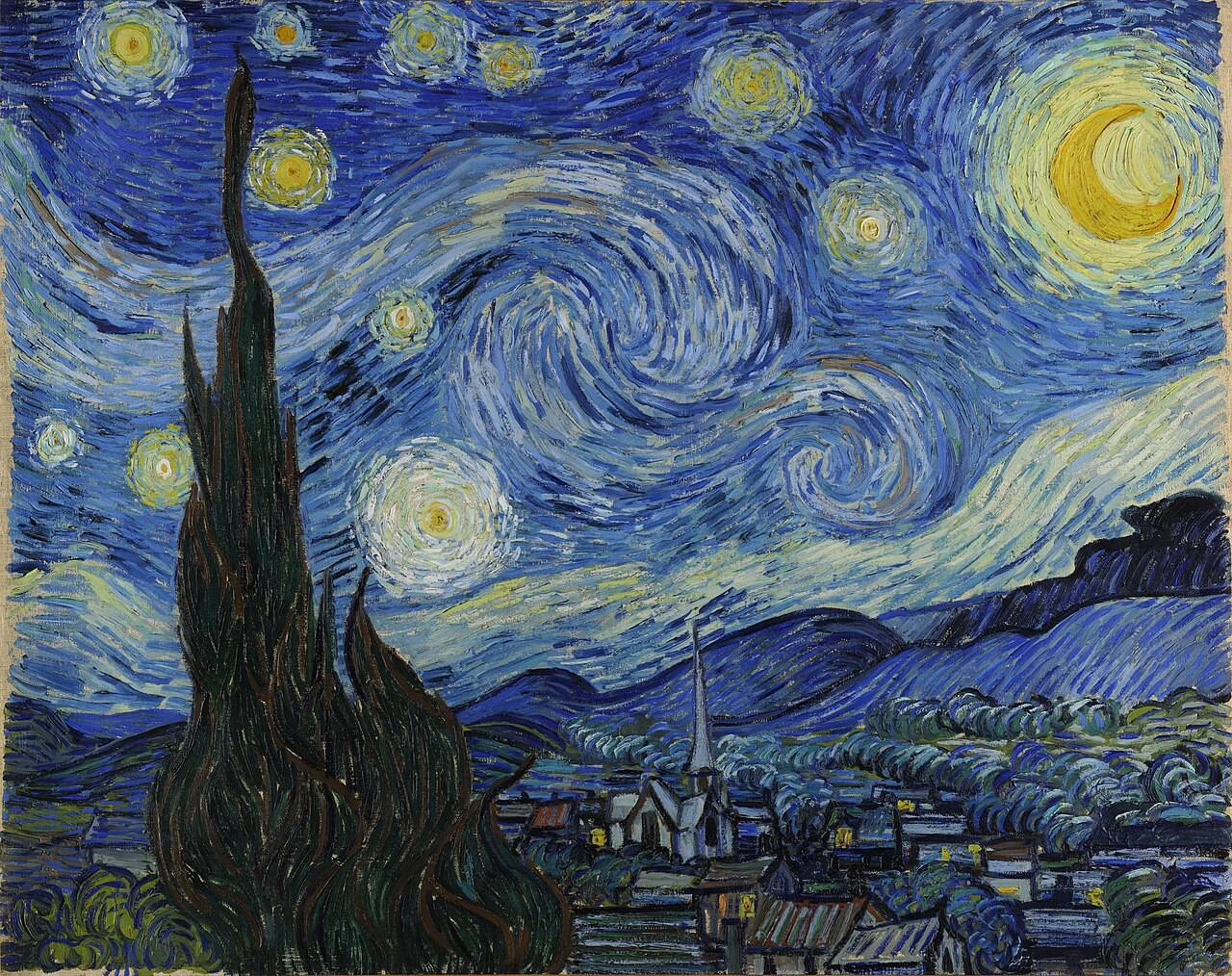
In 1889, Van Gogh was living at the asylum in Saint-Rémy. He observed the sky through his window, but instead of simply copying what he saw, he wove memory, observation, and imagination into a night scene full of movement. The familiar village sleeps below, while the sky seems alive and breathing.
Six details in the painting
Find these six places first, then look at the whole. The numbers match the dots on the painting.
SwirlsBrushwork
Up close, the strokes carry raised ridges of paint, called impasto. From afar a current of light; close up, paint with width and direction.
Morning starLight
Van Gogh wrote that before sunrise he saw only the morning star, “which looked very large.” Its glow owes as much to the deep blue around it as to the yellow.
CypressPerspective
The nearest tree covers part of the village and hills. That overlap builds depth: we seem to stand beside it, looking past it into the distance.
Crescent moonPigment
An orange crescent sits on a pale yellow disk, ringed by strokes of greenish white and light blue. The edges stay unblended, so the light spills past the moon.
SteepleComposition
The steeple rises too, but thin and straight against the cypress’s broad, wavering outline. One near, one far, the two verticals brace the spreading night.
WindowsPigment
A few yellow windows echo the great halos overhead, much more quietly. Sky and earth share the same colors.
Two ways of looking
Hidden Details
The cypress at the left rises like a dark flame, linking earth and sky. The village is not a faithful reconstruction of the view from the window, and the church steeple recalls northern architecture. Here, reality also embraces the world seen in the mind’s eye.
Another Way of Looking
Some viewers associate the cypress with death and eternity. This interpretation has cultural roots, but it should not be treated as the artist’s only intended meaning. Try covering the cypress and looking at the sky again: how does the balance of the whole painting change?
Inside the painting
Observation, Imagination, and the Language of Emotion
- 01Observation and Imagination
- 02Emotion, Vision, and an Individual Style
- 03A Dark Tree Gives the Sky Its Distance
- 04A New Experiment in a Letter
01Observation and Imagination
Read this section in full in the app.
02Emotion, Vision, and an Individual Style
Read this section in full in the app.
03A Dark Tree Gives the Sky Its Distance
The moon at the upper right is not a uniform patch of yellow. An orange-tinged crescent sits against a pale yellow disk, which meets short strokes of greenish white and light blue. The edges have not been blended into a soft haze. They remain visible in successive rings. Farther out, light and dark mingle, and the moonlight seems to extend beyond the moon itself.
The stars have halos of different sizes too. Against the deep blue sky, they create contrasts of both warmth and brightness. Their radiance depends on more than extra yellow: the changing darkness of the surrounding blues matters just as much. If everything were equally bright, there would be nowhere for light to appear. Van Gogh concentrates the most brilliant passages, while scattering paler strokes elsewhere to keep the eye from settling on a single star.
Seen closely, some brushmarks carry raised ridges of paint. Leaving paint thick enough to retain this relief is called impasto. It allows the same passage to do two things: from a distance it is a current of light; close up it is oil paint with width and direction. There is no need to assign a hidden meaning to every stroke. Following its bend and its stopping point is already a way of watching a painter organize a picture.
The cypress nearest us is dark, but it is not a silhouette filled with black. Follow it upward and slender brown and green strokes divide within the darkness. Its outline narrows, then swells. The sky’s strokes flow sideways; the tree’s rush upward. Their meeting gives the cypress its almost flame-like shape. The tree covers part of the village and hillside and interrupts a bright band in the sky. These overlaps establish depth: we seem to stand beside the tree, looking past it into the distance. The church steeple points upward too, but its thin, straight shape differs from the cypress’s broad, wavering outline. One near, one far, these vertical forms brace the horizontally spreading night.
Below, sloping rooflines and short, straight edges of walls gather the village into a compact group. A few yellow windows echo the great halos overhead, much more quietly. Sky and earth share their colors. We can be swept upward, then return to these small houses, with room for a table and a lamp.
04A New Experiment in a Letter
In his letter to Theo of around June 18, Van Gogh reported an olive-tree landscape alongside a new study of a starry sky. The editors identify the latter as The Starry Night. In the letter it is still a development in his work, mentioned alongside other paintings, waiting to be sent, seen, and discussed.
That small shift in perspective changes how we approach a masterpiece. We can briefly set aside its later fame and examine choices that still needed testing. Would making the dark tree so large overwhelm the sky? Could the village hold its ground beneath stars enlarged almost into disks? The painting offers concrete answers. The tree is large, but its tip is slender. The sky surges, but the houses below still fit firmly together. What looks daring rests on many small, precise decisions. [3]
Sources
-
MoMA: The Starry Night; excerpt from MoMA Highlights (2019)
The opening adapts the MoMA Highlights (2019) excerpt. The first two sections follow the museum’s essays on observation and imagination, and on Van Gogh’s emotion, vision, and style.
-
Van Gogh, Letter 777 to Theo, between about May 31 and June 6, 1889
The morning-star quotation at the start of section 1; other letter quotations and symbolic interpretations follow the museum essays listed in source 1.
-
Van Gogh, Letter 782 to Theo, around June 18, 1889
Reports an olive-tree landscape alongside the starry-sky study, identified as this painting in note 8.
-
Theo van Gogh, Letter 813 to Vincent, October 22, 1889
Theo questions the pursuit of style; note 9 identifies the moonlit village as this painting.
-
Van Gogh, Letter 816 to Theo, around November 3, 1889
Vincent defends his broader pursuit of more deliberate drawing.
-
Van Gogh, Letter 822 to Émile Bernard, around November 26, 1889
Self-criticism about oversized stars. Note 15 identifies a probable, rather than certain, reference to The Starry Night.